

As we move through 2026, the global landscape for climate, energy, and environmental policy has shifted from an era of “bold pledges” to one of “industrial execution.” Policy is no longer just about meeting distant targets; it is being used as a lever for national security, economic competitiveness, and supply chain resilience.
The rest of the article breaks down the key shifts you should watch for the remainder of this year.
Global Diplomacy: The Road to COP31
While COP30 (Brazil, 2025) focused on the “Belem Breakthrough” regarding nature-based solutions, 2026 is dominated by the preparations for COP31.
- The Turkey-Australia Partnership: Türkiye is the official host of COP31, but Australia holds the Presidency of Negotiations. This is a unique “North-South” bridge intended to centre the voices of Pacific Island nations.
- The “Era of Implementation”: Expectations for 2026 revolve around showing “receipts” for the 2030 targets. Watch for a heavy focus on Climate Finance and the Fossil Fuel Non-Proliferation Treaty, which Pacific nations are expected to champion aggressively.
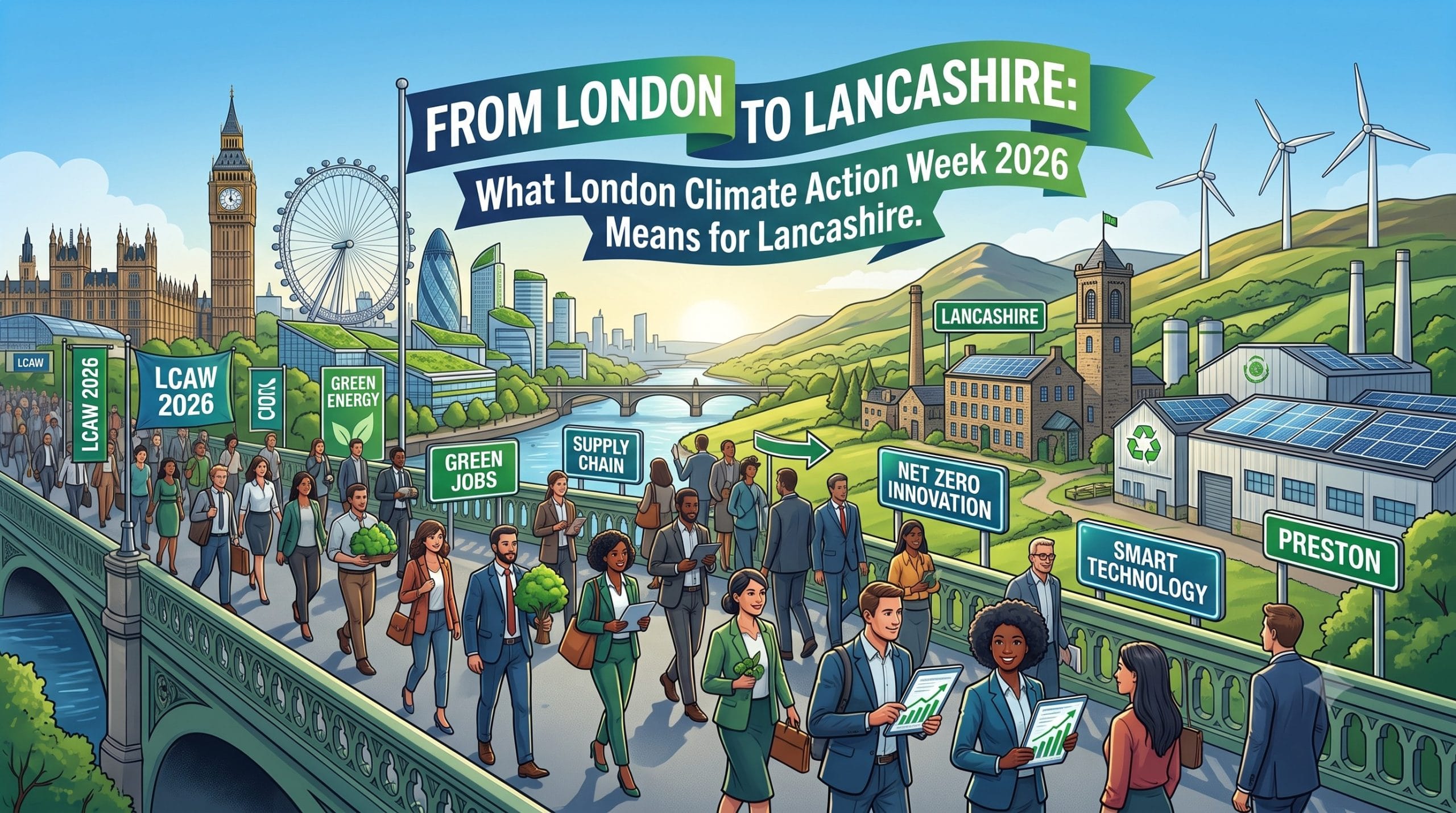
COPS a Plenty! East Lancashire Chamber of Commerce leading on behalf of the British Chambers of Commerce will be looking to take a delegation of Lancashire Businesses to COP 31 but also to COP 17 the Nature and Biodiversity COP to be held in Yerevan, Armenia in October this year. Keep your eye out for more information during the year or drop us a line if you want to find out more (info@chamberlowcarbon.co.uk)
Energy: A Tipping Point for Renewables
Energy policy in 2026 is driven by the reality that clean energy is now winning on cost, not just principle.
- Renewables Overtake Coal: 2026 is projected to be the first full year where renewables officially surpass coal as the primary source of global electricity generation.
- The AI Power Crunch: Governments are scrambling to regulate energy use for data centres. Expect new “Grid Priority” standards where AI developers may be required to co-locate with new renewable builds or invest in long-duration storage to avoid destabilising local grids.
- Industrial Policy as Climate Policy: Instead of simple carbon taxes, 2026 is the year of subsidies and “onshoring.” The US, India, and the EU are competing to build domestic “gigafactories” for batteries and electrolysers, often using trade barriers (like the EU’s Carbon Border Adjustment Mechanism) to protect these new green industries.
Regulation: The “Full Operationalisation” of ESG
For businesses, 2026 marks the end of “voluntary” reporting. Most major frameworks are now legally binding.
- The EU “Independence Moment”: The European Commission’s 2026 work programme focuses on circular economy and raw material security.
- Circular Economy Act (Q3 2026): New rules will likely mandate “digital product passports” and ban the destruction of unsold apparel.
- EU ETS Expansion: From 2026, shipping operators calling at EU/UK ports must fully participate in emissions trading schemes.
- Asia Adoption: China, Hong Kong, and Singapore are moving toward mandatory ESG reporting aligned with ISSB standards this year, effectively standardizing the “global language” of sustainability data.
- ISO 14001 As we move through 2026, the transition from ISO 14001:2015 to the new ISO 14001:2026 is the primary focus for environmental managers. The revision is a “light update” rather than a total overhaul, aimed at aligning the standard with modern environmental challenges like climate change and biodiversity loss.
The final version is expected to be published in April 2026 (with some sources suggesting an earlier release in Q1).
Key Changes by Clause
The revision maintains the Harmonised Structure (formerly Annex SL), making it easy to integrate with ISO 9001 and ISO 45001. However, several specific clauses have been refined.
| Clause | 2026 Update/Change |
| 4.1 & 4.2: Context | Climate & Biodiversity: Organisations must now explicitly consider climate change, biodiversity loss, and resource scarcity as external issues that affect their Environmental Management System (EMS). |
| 4.3: Scope | Life Cycle Perspective: When defining the scope of the EMS, the “life cycle perspective” is now a mandatory consideration rather than a suggestion. |
| 5.1: Leadership | Support for All Roles: Top management must now support all relevant roles (not just managers) to demonstrate leadership and commitment to environmental performance. |
| 6.3: Change Management | New Clause: A dedicated clause has been added for the “Planning of Changes.” This requires a structured process for any changes that could impact the EMS (e.g., new machinery, site moves, or process shifts). |
| 8.1: Operational Control | External Providers: The term “outsourced processes” is replaced by “externally provided processes, products, and services,” reflecting a broader responsibility for supply chain impacts. |
| 9.3: Management Review | Restructuring: The review is now split into three distinct sub-clauses: Inputs, Process, and Results, to create a clearer audit trail. |
| 10: Improvement | Consolidation: Clause 10.1 has been removed; its content on non-conformity and corrective action is now integrated into 10.2 and 10.3 to simplify the text. |
ISO 14001 Comparison: 2015 vs. 2026
The Transition Timeline
If your organisation is already certified to the 2015 version, here is the expected roadmap:
Publication (Q1/Q2 2026): The final standard is released.
Transition Period: A three-year window is expected (ending in early 2029), during which you must complete a transition audit.
New Certifications: Most accreditation bodies will likely stop issuing “new” certificates for the 2015 version about 12–18 months after the 2026 release.
Recommended Next Step
To prepare, you should perform a Gap Analysis against the Draft International Standard (DIS). This will help you identify if your current “Context of the Organization” (Clause 4) needs to be expanded to include specific biodiversity or climate adaptation risks.
Lookout for the revised and updated Chamber Green Rose programme being launched in April 2026! For more information contact info@chamberlowcarbon.co.uk
- B Corp’s new standards (Version 2.0, released April 2025) significantly raise the bar for certification, focusing on mandatory action in key impact areas like Purpose, Fair Work, JEDI (Justice, Equity, Diversity & Inclusion), Human Rights, and Climate Action, with stronger legal requirements for stakeholder governance and stricter rules on ineligible industries, aiming for clearer, more robust impact measurement and alignment with regulations like the EU’s Empowering Consumers for the Green Transition (ECGT) directive.
Key changes include closing loopholes, requiring action across all impact topics, and introducing third-party assurance for certification decisions, with the new pathway opening in 2026.
Chamber Low Carbon and 2030hub will be launching the updated B Impact Academy to reflect V 2.1 of the Standards) For more information contact info@chamberlowcarbon.co.uk
Key Environmental Standards to Watch
| Standard/Regulation | Focus Area | 2026 Milestone |
| ISO 14068 | Carbon Neutrality | Replaces PAS 2060; mandates “reductions first, offsets last.” |
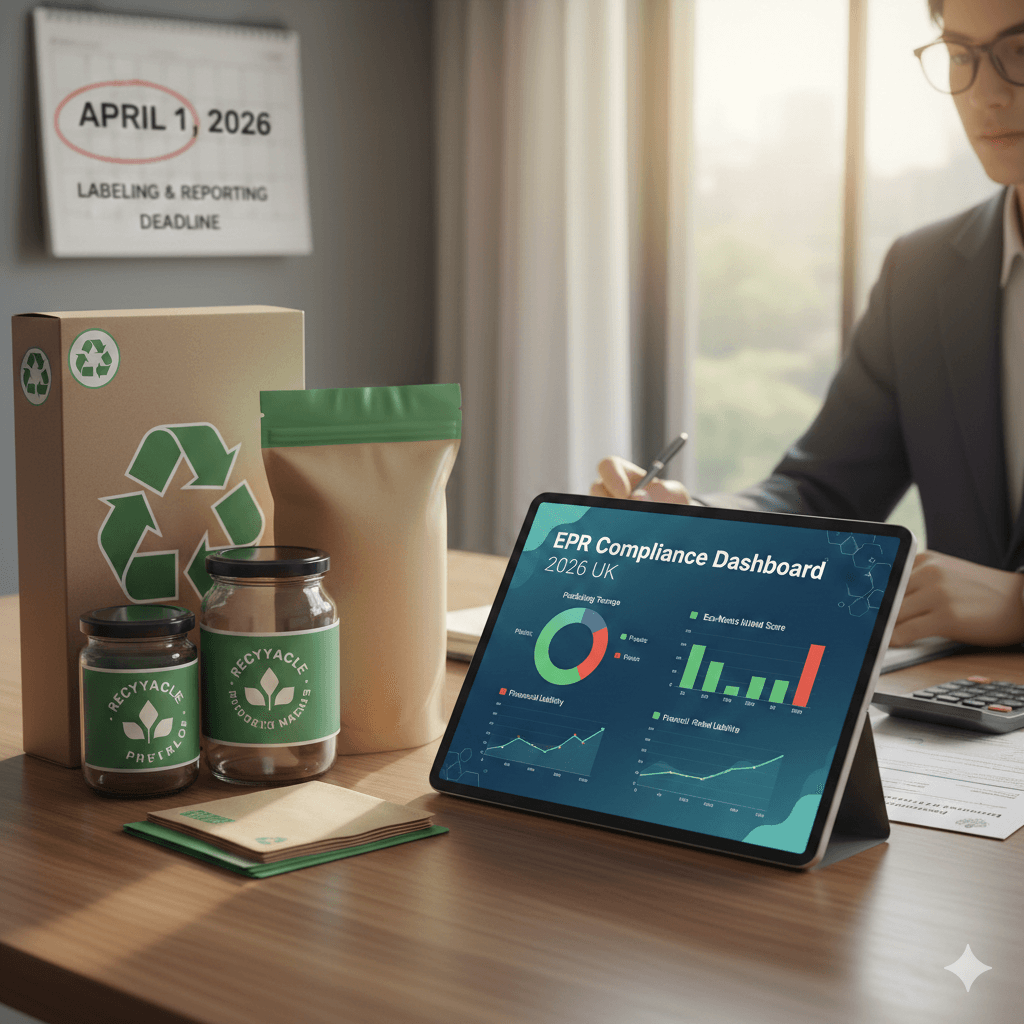
| UK EPR | Packaging Waste | Fees are now “modulated” based on how recyclable your packaging is. |
| ISO 14001 | Environmental Management | ISO 14001:2026 set to be published in April |
| B Corp | Sustainability | New Standards (Version 2.0) to be released April |
| Nature (TNFD) | Biodiversity | Nature-risk screening becomes a standard part of financial audits. |
| Greenwashing Rules | Consumer Protection | The EU and UK will begin imposing fines (up to 10% of turnover) for unsubstantiated “eco” claims. |
Summary: Themes for 2026
- Convergence: Climate, biodiversity, and finance are no longer separate departments; they are being integrated into a single “risk management” framework.
- Resilience over Ambition: Policy is shifting from “how much can we cut?” to “how can we survive?” as the world flirts with the 1.5 oC warming threshold.
- Data Accuracy: With the rise of AI-driven auditing, 2026 is the year of “audit-ready” environmental data. Companies can no longer rely on estimates; they need real-time monitoring and verification.
As always, the Chamber Sustainability Team are on hand to guide you through the year. For a free no obligation conversation to explore and map out your energy, climate and environmental management and reporting needs/issues contact info@chamberlowcarbon.co.uk or call 01254 356 487
Featured News

24 March 2026