
Implementing an Environmental Management System (EMS) allows an organisation to transition from reactive compliance to a proactive, strategic approach to sustainability. As of February 2026, the standard ISO 14001 is undergoing a significant update to align with current global priorities like climate resilience and biodiversity.
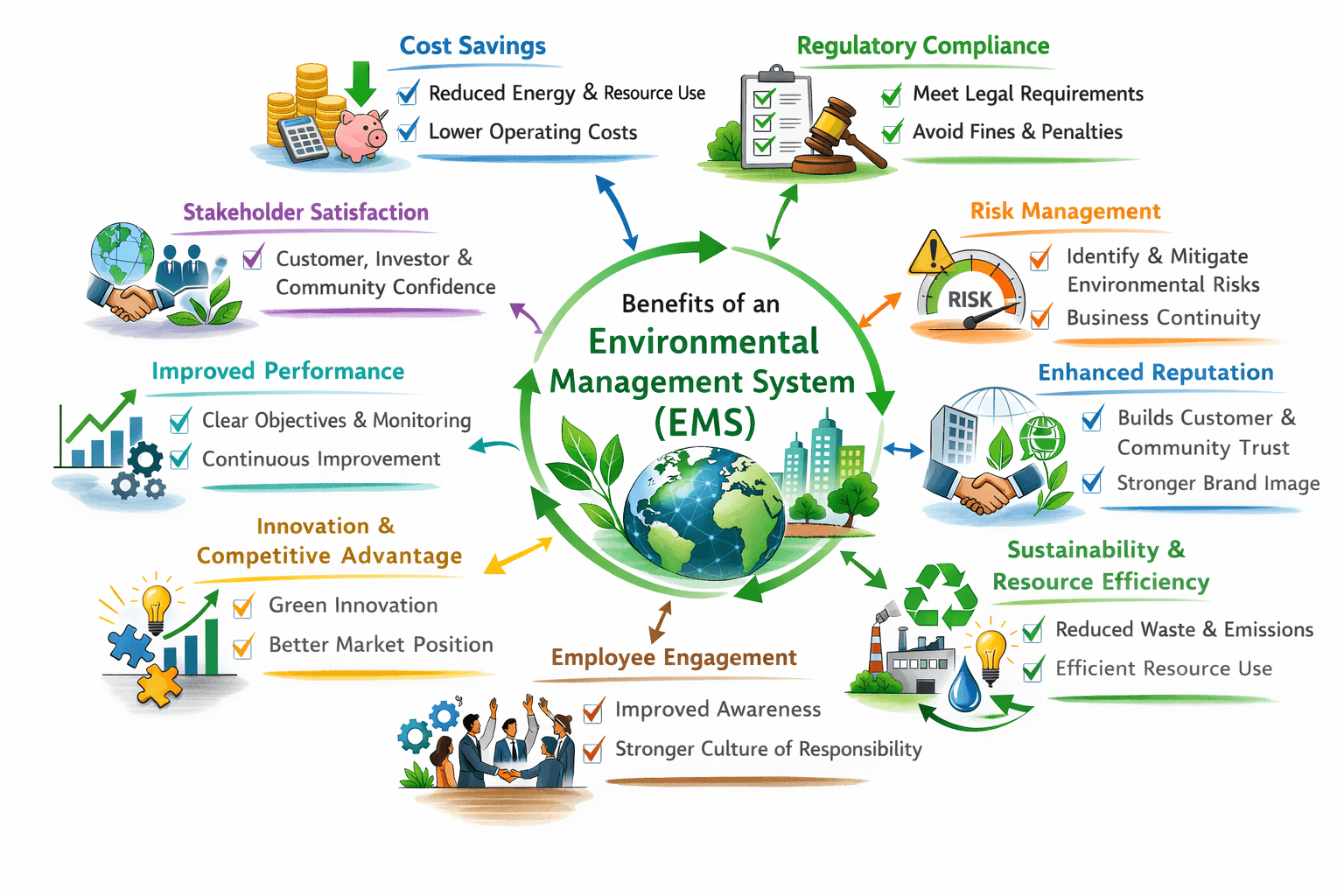
The Benefits of an EMS
Implementing a system like ISO 14001 provides a “triple bottom line” of benefits:
Operational & Financial Efficiency
- Cost Savings: Systematic tracking of energy, water, and raw materials identifies waste points, leading to lower utility bills and disposal fees.
- Process Optimisation: The Plan-Do-Check-Act (PDCA) cycle forces a rethink of inefficient production methods.
Risk Management & Compliance
- Legal Protections: A structured EMS helps you stay ahead of tightening environmental laws, drastically reducing the risk of fines and litigation.
- Operational Resilience: By identifying “environmental aspects,” companies prepare for disruptions like resource scarcity or extreme weather.
Market Reputation
- Competitive Edge: ISO 14001 is often a mandatory requirement for public sector and large-scale corporate tenders.
- Stakeholder Trust: It provides credible proof to investors and customers that your sustainability claims aren’t just “greenwashing.”
Which Standard?
While ISO 14001 is the global heavyweight, other frameworks exist depending on your region and goals:
| Standard | Scope | Key Feature |
| ISO 14001 | Global | The most widely recognized EMS framework; integrates with Quality (ISO 9001). |
| EMAS | Primarily EU | “ISO 14001 plus.” Requires public environmental statements and stricter reporting. |
| ISO 50001 | Global | Specifically focused on energy management and efficiency. |
| B Corp | Global | Broader ESG certification covering social, ethical, and environmental impact. |
Predicted Changes in ISO 14001:2026
The 2026 revision is the first major update in over a decade. It is currently in the Final Draft (FDIS) stage, with publication expected in April 2026.
Key Expected Shifts:
- Climate & Biodiversity (Clause 4.1): Organisations must now explicitly evaluate how climate change and biodiversity loss affect the context in which the business operates. It’s no longer optional to ignore these as “external factors.”
- Management of Change (New Clause 6.3): A dedicated requirement to plan and document changes (e.g., a new production line or supplier) to ensure they don’t accidentally damage your environmental performance.
- Life Cycle Perspective: A stronger push to look beyond your own “four walls” to include the environmental impact of your suppliers and the end-of-life disposal of your products.
- Leadership Accountability: Strengthened language requiring top management to show personal involvement and support all roles (not just managers) in environmental efforts.
- Refined Terminology: “Outsourced processes” is being updated to “externally provided processes, products, and services” to capture a broader range of supply chain risks.
The Transition Timeline
- April 2026: Official publication.
- 2026–2029: A typical 3-year transition window where organizations must move from the 2015 version to the 2026 version to remain certified.
If you are interested in finding out how the Chamber’s Sustainability Team can assist in the implementation of an environmental management system in your business or help you transition to the 2026 Standard then call or email 01254 356 487 / info@chambrelowcarbon.co.uk for a free, no obligation 1 hour consultation.
Featured News

24 March 2026