Think of the circular economy as the ultimate “undo” button for our current “take-make-waste” industrial model. Instead of digging things up, using them once, and burying them in a landfill, a circular economy keeps resources in use for as long as possible.
It’s essentially nature’s logic applied to business: in a forest, there is no such thing as “waste”—the output of one process is always the input for another.
Why the Circular Economy Matters
The traditional linear economy is hitting a wall. Here’s why switching to a circular model isn’t just “nice to have,” but a global necessity:
- Resource Scarcity: We are consuming earth’s resources 1.7 times faster than they can regenerate. Circularity reduces our reliance on raw material extraction.
- Climate Goals: About 45% of global greenhouse gas emissions come from how we make and use products. We can’t reach Net Zero through renewable energy alone; we have to change how we handle materials.
- Economic Resilience: By reusing materials, businesses become less vulnerable to volatile commodity prices and supply chain disruptions (like those seen in recent years).
- Waste Reduction: It tackles the pollution crisis at the source—designing out plastic in our oceans and electronics in our soil.
The R Strategies
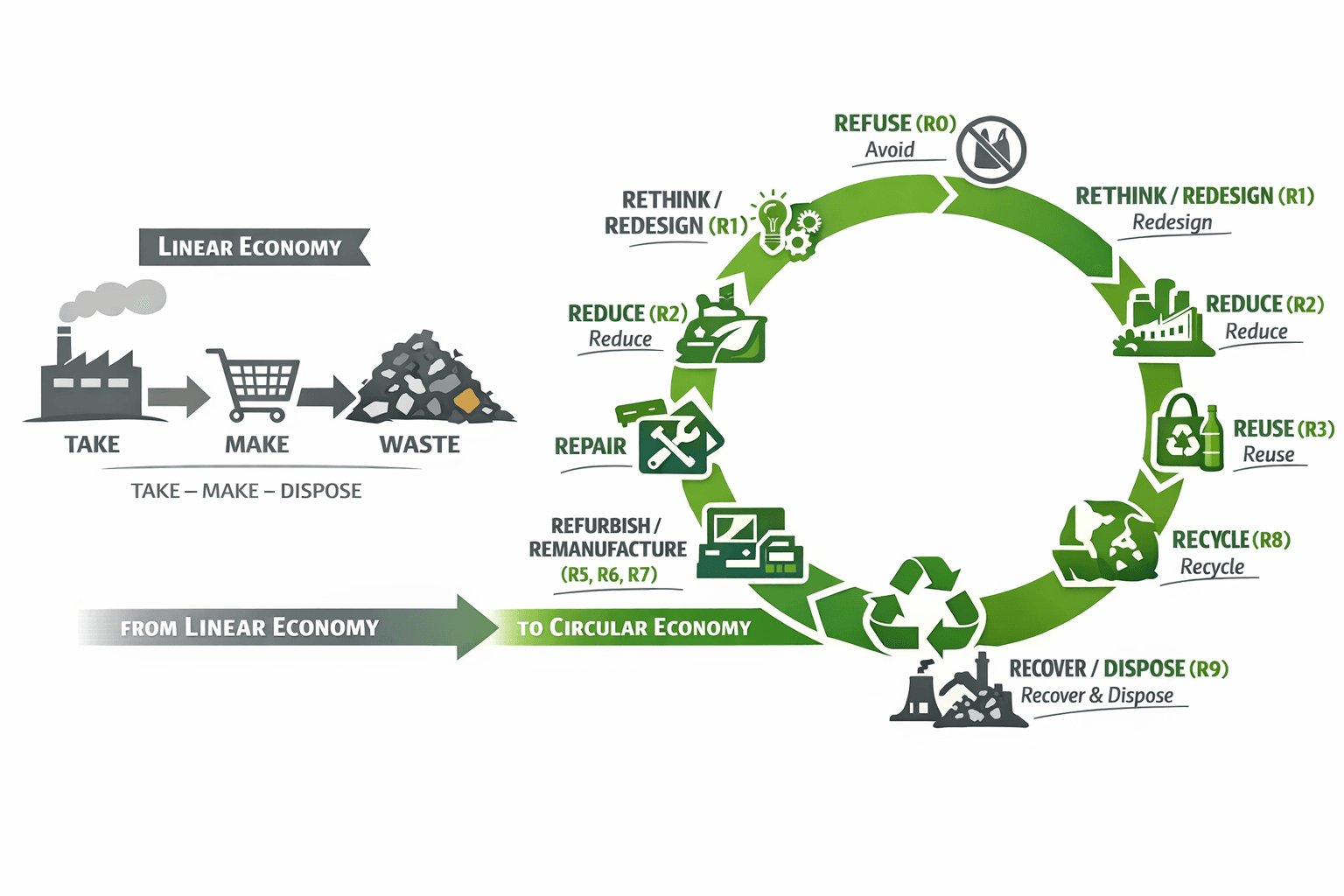
The circular economy hierarchy, often structured as R-strategies, prioritises resource efficiency by keeping materials at their highest value for as long as possible. It transitions from “take-make-waste” to a system focused on refusing, reducing, reusing, repairing, and recycling to minimise environmental impact.
The hierarchy is generally organised from most to least preferred:
- (R0) Refuse: Avoiding materials or products altogether.
- (R1) Rethink/Redesign: Making product use more intensive (e.g., sharing) or designing for efficiency.
- (R2) Reduce: Increasing efficiency in manufacturing or using fewer natural resources.
- (R3) Reuse: Reusing products that are still in good condition.
- (R4) Repair: Fixing, maintaining, or servicing products.
- (R5, R6, R7) Refurbish/Remanufacture: Updating, rebuilding, or repurposing old products.
- (R8) Recycle: Processing materials to create new products.
- (R9) Recover/Dispose: Incineration with energy recovery or landfill (least preferred).
This framework aims to turn waste into resources, fostering a closed-loop system.
Key Characteristics of a Circular Business
A circular business doesn’t just recycle; it reimagines the entire lifecycle of a product. Here are the core pillars:
Design for Longevity and Disassembly
Products are built to last but also built to be taken apart. If one part breaks, you replace the part, not the whole device.
- Example: A smartphone with a modular battery and screen that can be swapped out in minutes.
Product-as-a-Service (PaaS)
Instead of selling a physical item, the business sells the access or the result. The company retains ownership, which incentivizes them to make the product as durable and efficient as possible.
- Example: Signify (formerly Philips Lighting) sells “light as a service” to airports. The airport pays for the illumination, while Signify maintains the bulbs and hardware.
Resource Recovery and “Closing the Loop”
Waste is treated as a feedstock. This involves capturing nutrients or materials at the end of a product’s life to create something new.
- Example: An apparel brand that takes back old jeans to shred them into fibres for new denim collections.
Shared Platforms
Maximising the “utility rate” of a product. Most cars sit idle 95% of the time; circular models aim to keep assets in use through sharing.
- Example: Tool libraries or professional equipment sharing platforms.
Regenerative Inputs
Using non-toxic, renewable, or recycled materials that can safely return to the biosphere or stay in the industrial cycle indefinitely.
| Feature | Linear Business | Circular Business |
| Goal | Sell more units | Maximise resource value |
| Material Source | Virgin / Raw materials | Recycled / Bio-based |
| End of Life | Landfill or incineration | Reuse, Refurbish, Recycle |
| Customer Relation | Transactional (one-off) | Relational (long-term service) |
For more information on the Circular Economy join the Chamber Low Carbon Circular Economy Club or contact the Chamber Sustainability Team on 01254 356 487 or info@chamberlowcarbon.co.uk
Featured News

24 March 2026