
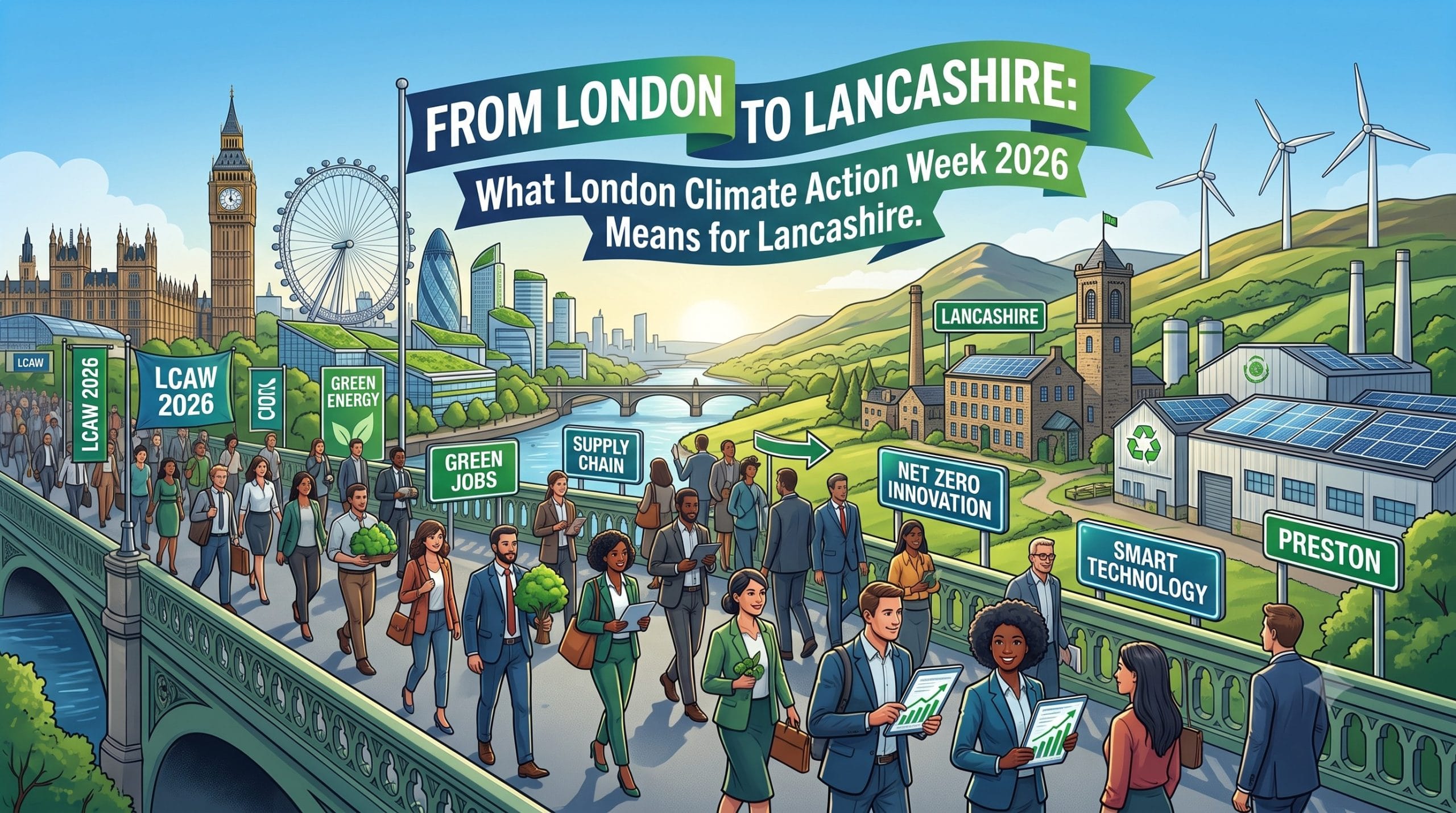
For Lancashire businesses global climate summits can often feel a world away. When global leaders and climate icons gather in grand venues down south, it’s easy to dismiss it as corporate posturing or high-level politics that won’t affect a manufacturing plant in Preston, a logistics firm in Blackburn, or a digital agency in Lancaster.
However, London Climate Action Week (LCAW) 2026—which it is estimated to have brought together 75,000 – 100,000 people across hundreds of events—was entirely different. This year’s theme shifted decisively from “ambition” to “implementation.” The overarching message ringing out from London is clear: the green transition is no longer a futuristic goal; it is an active economic shift.
For Lancashire’s businesses, this signals both a challenge and an unprecedented opportunity. Let’s break down the key highlights, the powerful messages from global and national personalities, and exactly how your business can turn these insights into commercial value and resilience.
The Big Hitters: Global Warnings and National Pathways
The week featured heavyweights from global diplomacy, climate science, and national policy. Their speeches mapped out exactly where regulations, funding, and supply chains are heading over the next few years.
- António Guterres: The Regulatory Reality Check
UN Secretary-General António Guterres did not mince his words. Addressing the international community, he emphasised that we are entering an era of strict accountability.
That the time for vague, mid-century promises is over. Governments and financial institutions are tightening the screws on emissions reporting, and this will cascade down through every single supply chain, hitting businesses of all sizes.
What this means for Lancashire SMEs: Large corporate buyers and public sector contracts are increasingly requiring suppliers to prove their green credentials. If you want to win tenders or remain a preferred supplier for larger firms in Preston, Burnley, or globally, having a handle on your carbon footprint is becoming a baseline requirement, not an optional bonus.
- Al Gore: The Trillion-Dollar Green Opportunity
Former US Vice President Al Gore brought his trademark energy to LCAW 2026, focusing heavily on the explosive growth of the green economy. Gore highlighted that market forces have shifted dramatically. Clean energy, energy-efficient tech, and circular business models are no longer just ethical choices—they are the most cost-effective options. He pointed out that trillions of dollars of private capital are actively seeking sustainable businesses to invest in and partner with.
What this means for Lancashire SMEs: Green innovation is a growth engine. Whether you are upgrading to energy-efficient machinery or developing a sustainable product line, the financial markets and local enterprise partnerships are structured to back you.
- Ed Miliband: The UK Powerhouse and Grid Reform
Closer to home, UK Energy Security and Net Zero Secretary Ed Miliband outlined the government’s aggressive roadmap to decouple the UK from volatile global fossil fuel markets. Miliband focused on accelerating local clean energy infrastructure, boosting grid capacity, and rolling out local energy hubs. He emphasised that local economies—like Lancashire’s rich manufacturing and engineering sectors—are vital to building this clean energy superpower.
What this means for Lancashire SMEs: Will this mean more localised support, grants, and incentives for commercial solar installations, building retrofits, and electrification? Some of this we are seeing now. It also means that future-proofing your business against energy price spikes requires adopting localised renewable solutions today.
- André Corrêa do Lago: Global Supply Chains and Bio-Economy
As Brazil’s Secretary for Climate, Energy and Environment and COP 30 President, André Corrêa do Lago brought a crucial international trade perspective. He highlighted how international frameworks are shifting to penalise deforestation and high-carbon manufacturing. He spoke extensively on how the global “bio-economy” is rewriting the rules of raw material sourcing.
What this means for Lancashire SMEs: If your business relies on importing materials, components, or agricultural goods, supply chain transparency is vital. Upstream carbon costs will soon reflect on your balance sheet.
4 Key Themes Impacting Lancashire Businesses
LCAW 2026 wasn’t just about speeches; it was a hotbed of tactical workshops. Four core themes emerged that directly intersect with the daily operations of a Lancashire businesses.
- Supply Chain “Scope 3” Pressures
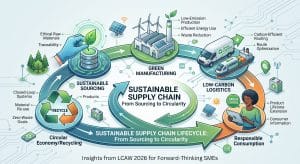
Large corporations are under intense pressure to report their Scope 3 emissions—which includes the carbon footprint of their entire supply chain.
- The Impact: If you supply components to an aerospace firm in Samlesbury or provide logistics for a major retailer, you are part of their Scope 3 emissions.
- The Action: Businesses that can proactively provide accurate carbon data to their clients will secure a massive competitive advantage over those that cannot.
- The AI and Data Centre Dilemma
A fascinating sub-theme this year was the intersection of Artificial Intelligence (AI) and climate change. While AI helps optimise logistics and reduce waste, the data centres powering it consume massive amounts of energy, water and land.
- The Impact: As Lancashire’s companies increasingly adopt AI tools for marketing, inventory, or manufacturing automation, their digital carbon footprints are rising.
- The Action: Transitioning to verified “green” cloud hosting and software providers is becoming a standard best practice.
- Circular Economy and Material Efficiency
With material costs remaining stubbornly volatile, LCAW placed a massive focus on circularity—keeping products and materials in use for as long as possible.
- The Impact: Lancashire’s manufacturing heritage makes us uniquely positioned to lead here. Waste from one process can become the raw material for another.
- The Action: Designing out waste from your production line doesn’t just save the planet; it directly insulates your bottom line from material inflation.
- Accessible Green Finance
Historically, green finance was reserved for multi-million-pound infrastructure projects. LCAW 2026 showcased a massive wave of new, downscaled financial products—including “green commercial mortgages” and sustainability-linked business loans with lower interest rates for SMEs that hit carbon reduction targets.
Your 4-Step Action Plan
Knowing what happened in London is one thing; knowing what to do on Monday morning in Preston or Blackburn is another. Here is a practical, jargon-free checklist to translate LCAW 2026 into local business growth:
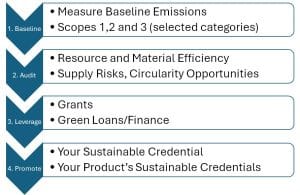
Step 1: Benchmark Your Carbon Footprint
You cannot manage what you do not measure. Start by calculating your Scope 1 (direct emissions from fuel you burn, like company vans) and Scope 2 (indirect emissions from electricity you buy) selected Scope 3 emissions (value chain in line with PPN 06/21) carbon footprint.
Step 2: Audit for Resource Efficiency
Before investing in expensive new tech, look at low-hanging fruit.
- Conduct an energy audit of your premises.
- Can you switch to LED lighting?
- Is your insulation up to par?
- Can your delivery routes be optimised using simple telematics software?
- Reducing energy consumption by even 15% to 20% strips pure cost out of your overheads.
Step 3: Tap into Local Green Grants
Funding is frequently available to subsidise commercial solar panels, air-source heat pumps, and energy-efficient machinery. Talk to your local authority, Chamber Low Carbon, or BOOST
Step 4: Talk About It Authentically
As Al Gore highlighted, consumers and B2B buyers actively prefer sustainable options. Once you start taking steps—even small ones—share your journey. Write a blog, update your LinkedIn, and include your green goals in your tender documents. Avoid “greenwashing”; be honest about where you are and where you want to go. Authenticity builds immense brand loyalty.
Conclusion: The View from the Red Rose County
London Climate Action Week 2026 proved that the green transition is no longer a top-down mandate driven solely by ethics. It is a bottom-up economic evolution driven by efficiency, supply chain security, and market demand.
Lancashire businesses have always been resilient, practical, and innovative. By adopting the practical strategies highlighted at LCAW 2026, our county’s businesses can cut costs, de-risk their supply chains, win higher-value contracts, and future-proof their operations for the decades to come. The future isn’t just green—it’s profitable.
Featured News

24 March 2026